
I usually tie up the treadles the way the tie-up in the article shows them. This often seems to mean that the tabby treadles are tied up on the left side and therefore I need to use my left foot for both of them.
I would like to use up this yarn by weaving baby blankets for a local Project Linus chapter.

When I become editor of Handwoven I had no idea that Handwoven’s Ruby Anniversary was coming and that my idea of a dream issue would mesh so perfectly with it.

On July 14, France celebrates Bastille Day (or as they call it “Quatorze Juillet”), the anniversary of the storming of the Bastille prison in 1789 that marked a turning point in the French Revolution—well, the first of their revolutions, anyway.
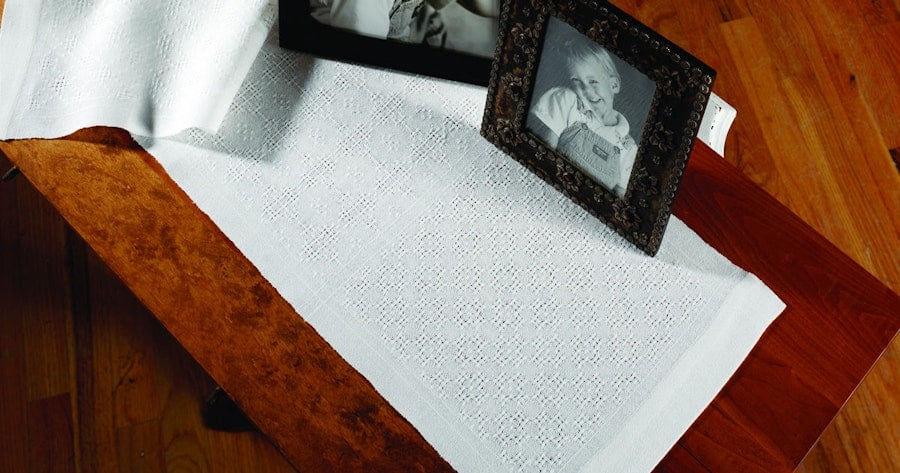
As Lynn Tedder writes in this article, originally published in the November/December 2018 issue of Handwoven, huck is a structure for all seasons.

Each Loom Theory is dedicated to a specific type of loom, either 4-shaft, rigid-heddle or 8-shaft loom.

This weekend, I threaded 430 ends of 20/2 cotton on my loom in 4 shades of gray from Lunatic Fringe’s Tubular Spectrum. It’s an easy threading of plain weave with some crammed ends of 10/2 cotton to create ribs in the fabric.
When I break a warp thread during weaving, it is always the thread on the far right (no matter if it is a floating selvedge or the first thread in the draft).
I am weaving some table napkins using a diamond pattern, Periwinkle from Marguerite Davison's A Handweaver's Pattern Book, and I find that the pattern comes out face down, i.e., upside down.
When beaming warps, I understand a lot of weavers like to use water-filled recycled plastic bottles with handles as weights. Can you suggest another thing that can be used as a weight?