
We heard from a weaver recently who asked why projects have such unusual weaving widths. Furthermore, how would we suggest they measure the 89⁄15" width listed in the project they were looking at?
Do I really need a ruler capable of measuring that peculiar fraction of an inch, they asked? Thankfully, no—because while those width numbers may look like fractions, they have a very different meaning in the context of weaving drafts.
Width in the Reed
Flipping through an issue of Handwoven, we found weaving widths of 162⁄8", 109⁄10", and 113⁄12", among many others. Some projects even included two widths, such as 205⁄9" or 206⁄12".
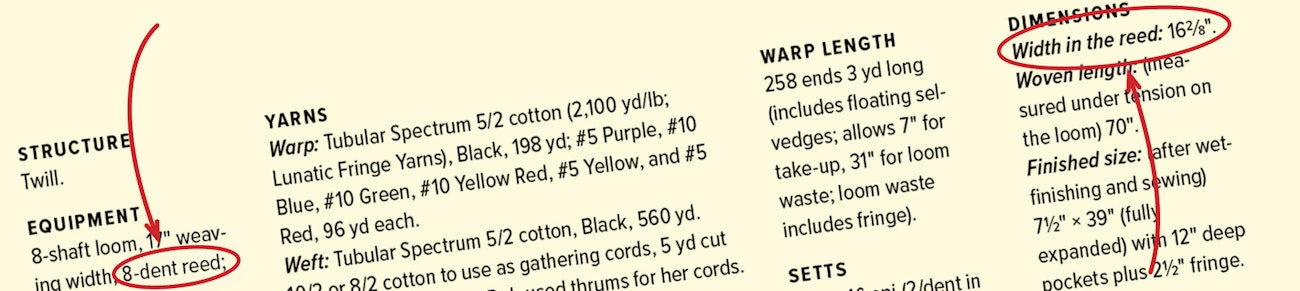
If you look at the equipment list for that 162⁄8"-wide project (above), you’ll see that it uses an 8-dent reed. What a weaving width (or width in the reed) of 162⁄8" means is that the project will be 16" wide in the 8-dent reed plus 2 dents.
The 109⁄10" project mentioned earlier will be 10" wide in a 10-dent reed plus 9 dents, while the 113⁄12" project will be 11" wide in a 12-dent reed plus 3 dents.
When two widths are listed (205⁄9" or 206⁄12"), the project suggests two reed options. You can use a 9-dent reed and your project will be 20" wide plus 5 dents, or you can use a 12-dent reed and your project will be 20" wide plus 6 dents.
Summing it Up
When it comes to weaving width, the whole number is a measurement in inches. The denominator of the “fraction” tells you the size reed that’s used, and the numerator tells you how many additional dents your project will require when you sley that reed. And if there’s no fraction listed as part of the width, the project doesn’t use any additional dents beyond the whole number measurement.
Historical note: In older (pre-2000 era) Handwoven drafts we’ve found that widths are expressed in true fractions; over the next handful of years those fractions seem to be a blend of mathematical measurements and the reed-related measurements described above.