
Subscribe to The Long Thread Podcast:


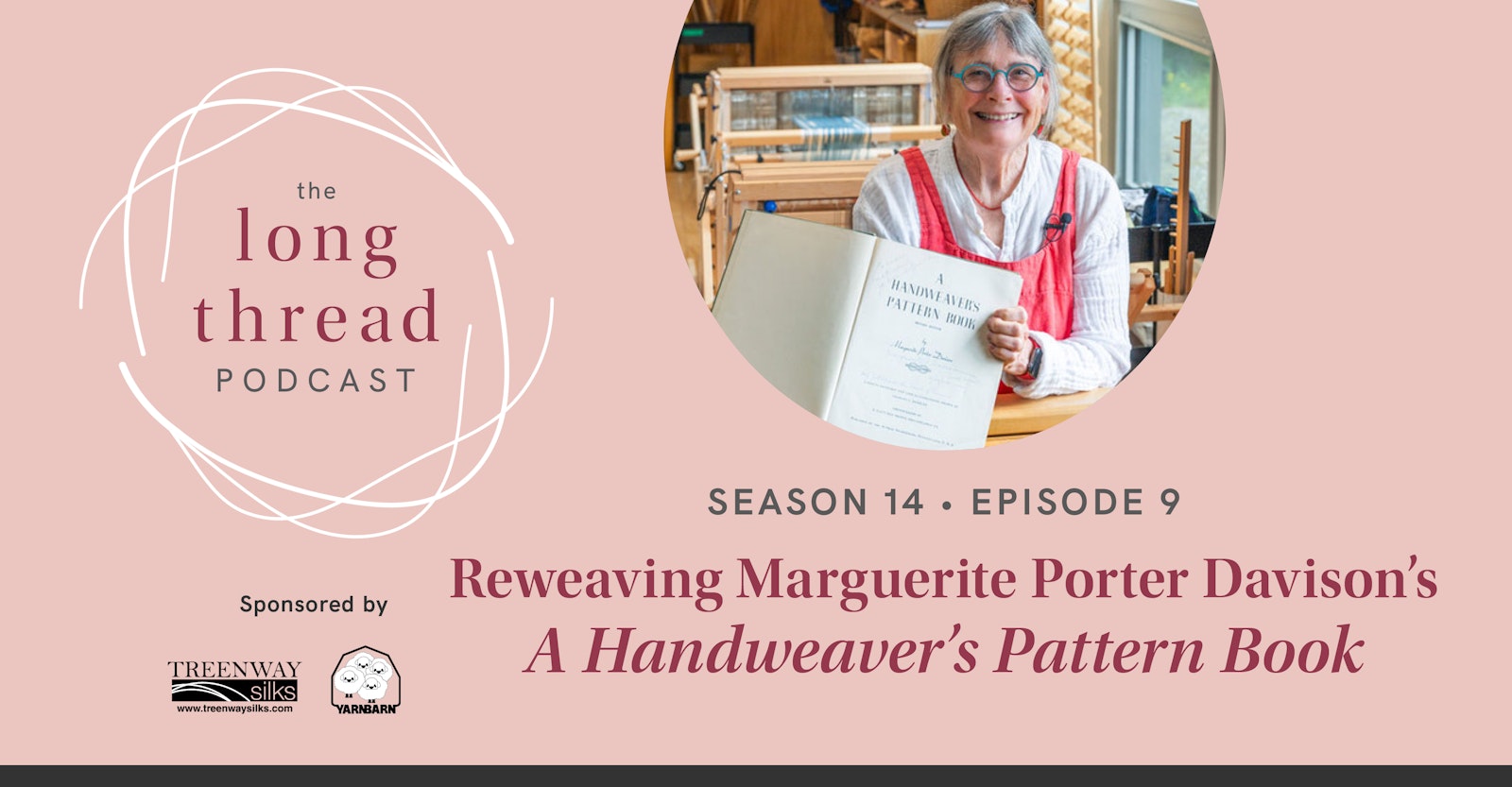
Among four-shaft weavers, A Handweaver's Pattern Book is commonly referred to by just the author’s name—Davison—or as “the green book,” a reference to the iconic cover of many of the book’s printings. Since Marguerite Porter Davison first published it in 1944, it has been a foundational reference, the first book that many weavers buy and the one they keep close at hand. Packed with drafts and photographs for overshot, twill, crackle, and dozens of other structures, it’s the weaver’s answer to The Joy of Cooking: a starting point for design, a resource for understanding a structure, and a map for exploration. Although it remained in print for decades, it became unavailable in 2005, and the weaving community felt the loss.
For the past several years, a group of nearly 100 weavers and other volunteers has been working to bring it back. Weavers from guilds from coast to coast have nearly finished reweaving all of the book’s samples—more than 1,200 of them—in color. Technical reviewers have created contemporary drafts. The original instructions for sinking-shed looms have been adapted to the jack looms more common in most weavers’ studios. Despite the updates, the project’s north star has been to honor Davison’s voice and intentions. The updated edition, to be published by Schiffer Craft, is expected in summer 2027.
Leading the effort is Caroline Cooley Browne, who happens to be Marguerite Porter Davison’s granddaughter. Davison died when Caroline was a baby, but she grew up hearing stories from her mother of warping looms in Marguerite’s attic studio, of train rides to the printer, of the woman who traveled to numerous guilds because she loved being with other weavers. When the copyright to the 1951 edition eventually came to Caroline through her family, she knew what to do with it, and she enlisted a team of eager volunteers to help bring the new edition to life.
In this episode, Caroline is joined by Donna Johnson of the Whidbey Weavers Guild, who coordinates volunteers for the guild’s sample weaving, and Anita Osterhaug, who connected the project with the publisher and has been part of the technical steering committee. Together they talk about the logistical undertaking of standardizing hundreds of samples across dozens of weavers, the technical decisions involved in updating the book, and what it has felt like to be part of the next chapter of something this important.
Listen in to hear why the green book has never gone out of fashion, what surprised the weavers as they worked through structures they’d never tried before, and what Marguerite Porter Davison’s granddaughter hopes she would think of the whole endeavor.
Links
- Visit the page dedicated to The Big Weave on the Bainbridge Artisan Resource Project (BARN) website and sign up for updates. When the project is finished, the WIFs will be available through BARN
- Find more information and preorder the book at Schiffer Publishing
This episode is brought to you by:

Treenway Silks is where weavers, spinners, knitters and stitchers find the silk they love. Select from the largest variety of silk spinning fibers, silk yarn, and silk threads & ribbons at TreenwaySilks.com. You’ll discover a rainbow of colors, thoughtfully hand-dyed in Colorado. Love natural? Treenway’s array of wild silks provide choices beyond white.
If you love silk, you’ll love Treenway Silks, where superior quality and customer service are guaranteed.

“Hi, I’m Gabi van Tassell from Bluebonnet Crafters, and I’m the inventor of TURTLE pin looms. Pin looms are small, handheld looms that quickly weave self-contained fabric pieces like squares, hexagons, and more. Weave them with almost any yarn you have on hand, then combine them into projects of any size. They make a wonderful companion for any fiber lover, at home or on the go. I’d love for you to visit us at turtleloom.com to explore the full loom catalog, patterns, and more. Hope to see you there.”