
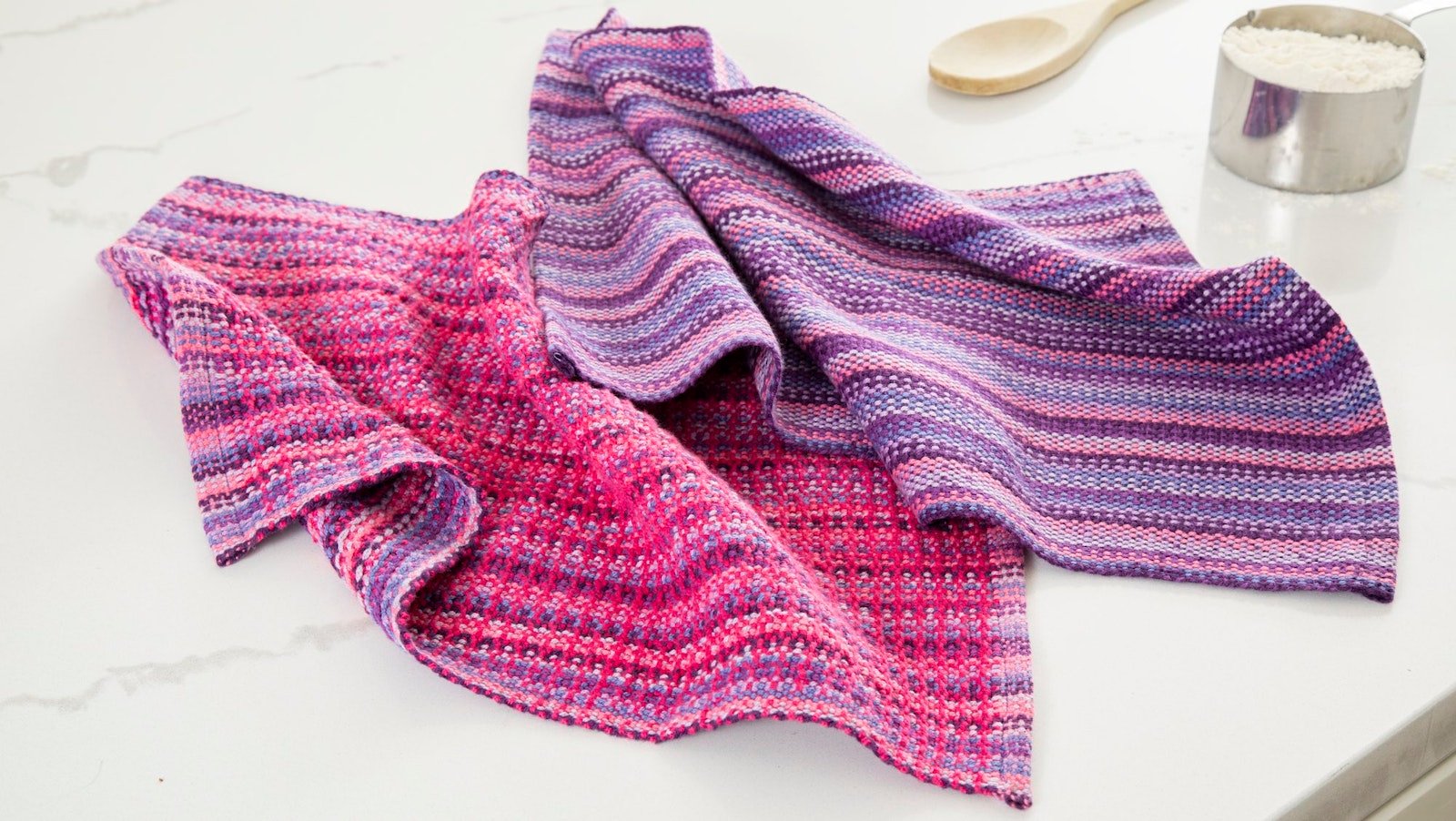
While organizing my stash of 8/2 cottons and cottolins, I realized I had a sizable collection of different purples. As I surveyed this variety of violets, I had a fit of inspiration: What if I used these purples as the basis of a randomly striped warp for towels? I could do it on my rigid-heddle loom using the direct-warping method, so I could see the warp stripes on the loom as I threaded the heddle.
I assumed (foolishly) that I would intuitively know when to change colors, as well as which color I should pick next. It became clear almost immediately that vibes alone wouldn’t work. After a few false starts I developed a method that I call the “Rule of Three”, and used it to guide the threading for what became my Rule of Three Towels.
 Looking at Christina's warp for her Rule of Three Towels, you’d never know that she followed a strict set of rules to create her warp-color order. Photo by Christina Garton
Not So Random
Looking back, I realized that I didn’t actually want a random warp—I wanted the weaving equivalent of the delicious meal that a good cook can throw together from whatever they have on hand.
I think a lot of the time when we say “random” in regard to weaving, what we really mean is a design that is asymmetric, but still balanced—with pattern or color changes that feel organic. Even if there appears to be no rhyme or reason behind the design, everything still looks cohesive.
I don't know if there’s a concise term for this type of design (I bet there is in German), so I like to think of it as semi-random, planned-random, or, if you prefer, controlled chaos.
Design Helpers
I had hoped to achieve this look through intuition alone, but I ended up needing some firmer guidelines. If you want cloth with an asymmetric design and an organic vibe, you can use the Rule of Three as I did, or you can try one of these other methods:
Use the Fibonacci Sequence. This is an infinite series of numbers where each number is the sum of the two previous: 1, 1, 2, 3, 5, 8, 13, 21, and so on. You can use the sequence to determine size of stripes, number of repeats, and so much more. Read more about the Fibonacci Sequence (and its math buddy, the Cantor Set).
 For her aptly named Fibonacci Sequence Scarves from Little Looms 2017, Margaret MacMorris used numbers from the Fibonacci sequence to guide her asymmetrical striped design. Photo by Joe Coca
Look to the Weather. For her Summer Sorbet Towels in Handwoven Summer 2026, Barbara Mitchell let the high temperatures for the month of August 2025 guide her warp color order. The results are simply stunning. Because temperatures (usually) increase gradually, using those numbers to guide your design often results in really nice color shifts and a well-balanced design.
 For her Summer Sorbet Towels, Barbara Mitchell assigned colors to different temperature ranges and then came up with a warp color order based on the high temperatures for a one-month period. Photo by Matt Graves
Try a Random Stripe Generator. You can find a variety of random stripe generators online. Most of them work similarly—you enter your chosen stripe widths, colors, and some other factors (such as number of repeats or final measurement) and then the generator creates a striped pattern based on that information. If you don’t like what you see, you can click to get a new pattern, or adjust your inputs and try again.
 Sarah H. Jackson used a random stripe generator as she designed the stripes for her Biscuits and Jam scarf from Handwoven May/June 2017. Photo by George Boe
There are many other methods for making semi-random designs, so don't feel like you’re limited to just this list—I've even heard of weavers basing stripe patterns on barcodes.
Happy Weaving!
Christina