
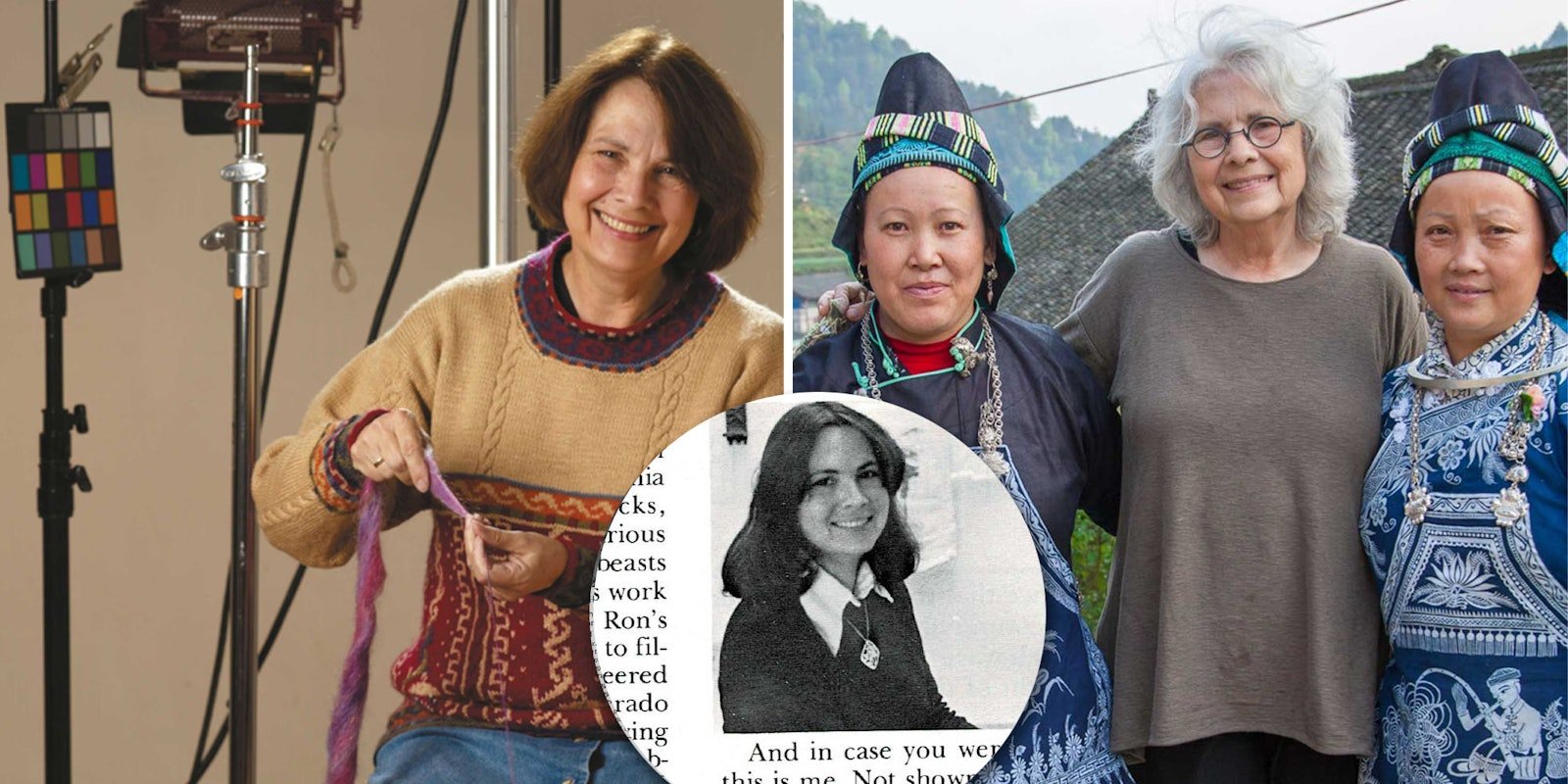
In the mid-1970s, the back-to-the-land movement was in full swing, and many of those interested in self-sufficiency and lives of personal meaning took up fiber crafts. Linda Ligon found weaving an “absorbing sideline” to her full-time job as a high school teacher and her commitments as a wife and mother. When a third baby joined the family, she quit her teaching job and began thinking about a new venture.
Looking back at that moment, Linda said, “A publication about my favorite subject seemed a good way to combine all the things that I liked to do when I found myself at home full-time.”
At her dining room table in Loveland, Colorado, she turned this idea into a magazine about fiber arts in the mountain/plains region, titling it interweave. The first issue appeared in the fall of 1975.
In 1977, Linda spun off a magazine aptly called Spin-Off, treating handspinning as an interesting craft and rescuing it from, as Lee Raven said, “the backwaters of the textile crafts.” From that seed grew the premier publisher of magazines and books about not only handweaving, but also all kinds of needle arts, jewelry, and even herbs.

Left: The first issue of Handwoven was published in 1979. Right: At the very beginning of her publishing career, Linda founded interweave magazine (Handwoven’s predecessor). As she described it in the staff page from the second issue of interweave in 1976, “In case you were wondering, this is me. interweave is a down-home production. The kids lick stamps for 25 cents an hour (don’t tell the labor department), I do photography in the laundry room and layout on the dining room table. The production schedule is designed to leave May free to help put in a garden, and August free to freeze it up.”
The Birth of Handwoven
One day in the late 1970s, Linda had a lively lunchtime talk with Barry Schacht (of Schacht Spindle Co.) and Halcyon Blake and Hector Jaeger (founders of Halcyon the Weaver’s Friend, which became Halcyon Yarn).
“We talked a lot about handweaving,” says Halcyon, “and how we all thought that weavers would love to have projects presented in a way that would let them just ‘get weaving.’” Although there were other resources and magazines for weavers, the idea of weaving recipes wasn’t represented.
“There seemed to us to be a snooty assumption that if you didn’t do all that work you were somehow not a ‘true’ handweaver, and we all felt that was just counterproductive to growing the crafts we loved,” says Halcyon.
“Lo and behold, a year later, Linda came out with the first issue of Handwoven,” recalls Barry, “and it was spectacular. And it began to grow in size and was extremely responsible for the growth of handweaving and handweavers.”
Jane Patrick (who worked with Linda for a dozen years and served as the magazine’s editor from 1985 to 1992) adds, “When Handwoven first came out, it felt like it had been created just for me—a new weaver hungry for knowledge and inspiration.”
Linda shared work from the most influential and interesting weavers in magazines and related projects such as videos, courses, and design collections.
“Linda cared—and still cares—not only about the crafts themselves but also about the people who do them and the businesses that support them,” says Jane. “More than anyone else, she nurtured the spinning and weaving community, growing it through magazines, books, conferences, and her unwavering support of craftspeople.”
Looking Forward
In 2005, Linda sold the company, remaining on the board for several years and eventually beginning Thrums Books, which focused on textiles from around the world. In 2019, believing that it was time for Handwoven, Spin Off, and PieceWork to come back to the hands of editors and weavers, she joined me and publisher John Bolton to form Long Thread Media, a women-owned company dedicated to craft publications.
As time passes, magazines leave the shelves and fabric wears away, but the knowledge and meaning persists.
“I hope one day some kid combing through the stacks of whatever a library looks like 50 years from now finds a book or magazine about weaving from one of the authors Interweave, Thrums Books, or Long Thread published,” says Liz Gipson, who spent time on Handwoven’s staff. “I hope they get the same kind of chill running up their spine that I did.”
Read the entire piece, including memories of Handwoven over the years from Madelyn van der Hoogt, Deborah Chandler, Daryl Lancaster and others in the Winter 2025 issue.
ANNE MERROW is a cofounder of Long Thread Media. She serves as the company’s editorial director, and she weaves, spins, and knits in Fort Collins, Colorado.