
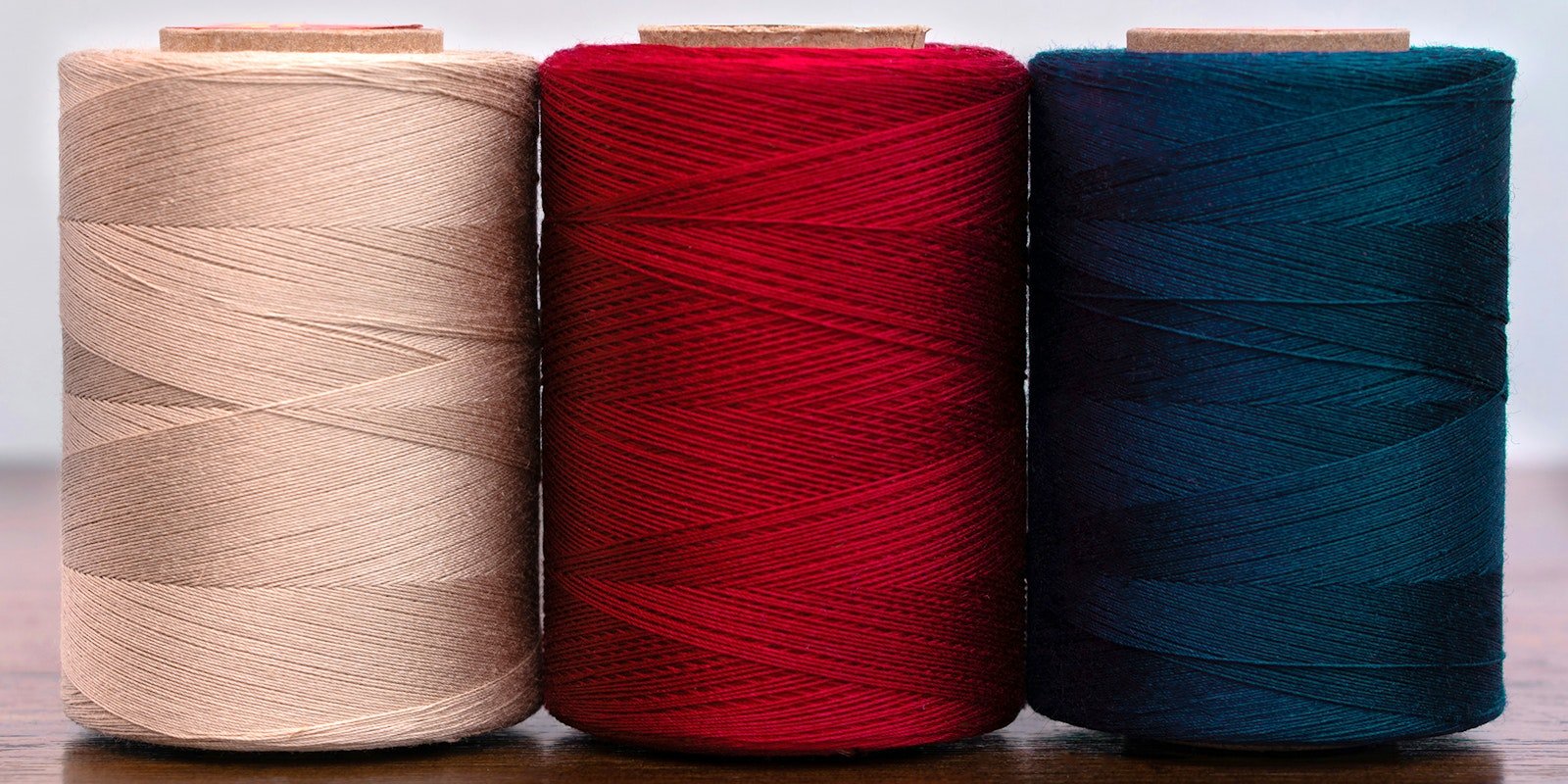
Dear Madelyn,
I’ve been weaving a long time, and I think I learned way back when I began that in weaving yarn, the size 5/2 means the yarn has five twists to the inch and it’s made up of two singles yarns plied together.
Now I see yarns described as 2/14, 4/14, 4/10, and they don’t look like they have that many singles plied together. Is my understanding stuck in the olden days?
Thank you!
Lucy
Hi Lucy!
Yarn counts cause great confusion even when they are used consistently—and in the case of weaving yarns, they are not. The source that explains this best (and I consult it often) is The Weaver’s Companion. Here’s a summary of what it says about yarn size.
Spoiler alert: The number of plies in a yarn comes into the picture, but the number of twists per inch doesn’t!
About the Numbers
One of the numbers in a yarn size (the 10 in a 10/2 cotton, for example) is based on the number of yards in a pound of a single strand of arbitrary thickness—also known as the count for that fiber. That single strand is considered a #1. There are 840 yards per pound in a #1 strand of cotton, silk, or Tencel. Other strand thicknesses are multiples of the count, so a #10 strand of these fibers will have 8,400 yards per pound.
The other number given for a yarn (the 2 in our 10/2 cotton) tells you how many of the specified strands or plies are in the yarn. In 10/2 cotton, there are two plies of #10 strands. Each of those strands is 8,400 yards per pound, so the 10/2 cotton as a whole will be 4,200 yards per pound, and 10/4 cotton will be 2,100 yards per pound. If we think about 5/2 cotton, a single #5 strand is 4,200 yards per pound (840 times 5), so the two strands in 5/2 will be 2,100 yards per pound—the same weight as 10/4 cotton.
While silk uses the same count system as cotton, silk yarn for weaving is usually loftier than cotton. As a result, although 20/2 silk is the same weight as 20/2 cotton, it appears almost as thick as 10/2 cotton. This effect definitely varies, depending on the degree of twist in a particular yarn.
Other Fibers
An additional source of confusion occurs because the arbitrary number for a #1 strand is not the same in all fibers and yarns—it’s 840 yards per pound for cotton, silk, and Tencel, 300 yards per pound for linen, 256 for woolen-spun wools, and 560 for worsted-spun wools.
Cottolin, which is a blend of cotton and linen, is an odd case. Some manufacturers use the linen count for cottolin (300 yards per pound), while others use the cotton count (840 yards per pound). This is why 22/2 cottolin (which is based on the linen count) is about the same size as 8/2 cottolin (which is based on the cotton count) despite their naming difference. In fact, 22/2 cottolin (3,170 yards/pound), 8/2 cottolin, and 8/2 cotton (both 3,360 yards/pound) can be used together or substituted for each other without difficulty.
To add one more element of confusion, different yarn manufacturers list the numbers in a different order—they might use 2/8 instead of 8/2, for example. At Handwoven, we try to consistently give the weight number first, and the ply number second.
Summing things up, the higher the top number in the same fiber, the finer the yarn: 5/2 cotton is twice as thick as 10/2 cotton and 20/2 cotton is twice as fine; and 8/2 wool is a lot thicker than 20/2 wool. The higher the bottom number, the thicker the yarn: 10/4 cotton is twice as thick as 10/2 cotton.
Comparing relative sizes of different fibers is harder because they are based on different counts. Whenever I have questions about the relative thickness of yarns and how they should be sett, I consult the Master Yarn Chart.
—Madelyn
The Weaver’s Companion is out of print, but it’s often available in guild or public libraries, and sometimes you’ll even run across a used copy. If you do, snap it up!
If you have a weaving question we would love to hear from you!
Published Oct. 24, 2017; updated April 8, 2026.