Subscriber Exclusive
Weave an Expandable Bag that Harnesses the Power of Twill
Alternating hills and valleys are the key to stretchability in this new exclusive project.
Alternating hills and valleys are the key to stretchability in this new exclusive project. <a href="https://handwovenmagazine.com/stretchy-stripes-bag-exclusive/">Continue reading.</a>
https://handwovenmagazine.com/cdn-cgi/image/format=auto/https://www.datocms-assets.com/75077/1761773866-hwwn25-stretchy-stripes-bag.jpg?auto=format&w=900
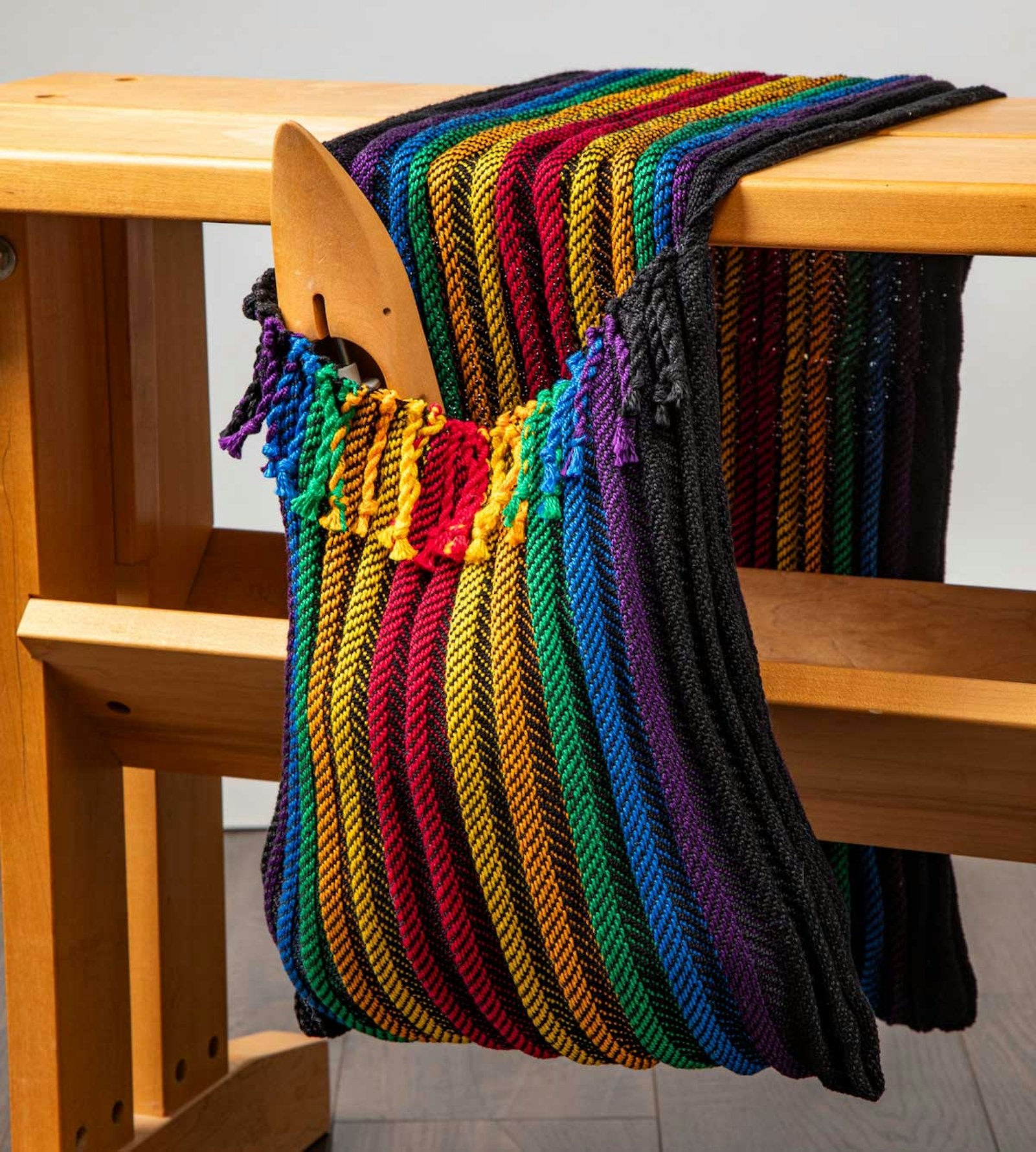
The brilliant colors may be what you notice first about Deb Essen’s design. On a closer look, you’ll see that the structure—simple twill stripes—produces irresistibly touchable results. Who doesn’t want to stretch this fabric out and watch it spring back when you let it go, over and over again? If you don’t need a bag, Deb suggests using the piece as a shawl, where you can do that all day long!
Read on to learn more about this project, developed exclusively for the Winter 2025 issue of Handwoven, or head to the library to access the project PDF and WIFs. Please enjoy this subscriber bonus project from the Winter 2025 collection.—Handwoven editors
About the Stretchy Stripes Bag
Back in the early 2000s, my weaving guild brought Celia Quinn in to teach spinning and weaving classes. One of the samples we made in the weaving class alternated bands of 1/3 and 3/1 twill to create pleats that ran the length of the fabric.
SUBSCRIBER EXCLUSIVE
The brilliant colors may be what you notice first about Deb Essen’s design. On a closer look, you’ll see that the structure—simple twill stripes—produces irresistibly touchable results. Who doesn’t want to stretch this fabric out and watch it spring back when you let it go, over and over again? If you don’t need a bag, Deb suggests using the piece as a shawl, where you can do that all day long!
Read on to learn more about this project, developed exclusively for the Winter 2025 issue of Handwoven, or head to the library to access the project PDF and WIFs. Please enjoy this subscriber bonus project from the Winter 2025 collection.—Handwoven editors
About the Stretchy Stripes Bag
Back in the early 2000s, my weaving guild brought Celia Quinn in to teach spinning and weaving classes. One of the samples we made in the weaving class alternated bands of 1/3 and 3/1 twill to create pleats that ran the length of the fabric. [PAYWALL] Since then, I’ve wanted to use this technique in a project but never got around to it. When I saw the “Hills and Valleys” theme for this issue of Handwoven, I decided it was time!
While the fabric may look complex, the weaving is easy and goes quickly. I used a straight-twill threading tied up for turned-twill patterning. Because each block of twill threading and treadling runs the length of the fabric, it’s a simple matter to gather the fabric into pleats. After wet-finishing to lock the pleats in place, the fabric is free to expand and contract. I’ve woven this draft in wool and cotton and have found that both fibers work well. I haven’t tested the holding power of the pleats with a rayon yarn, but it’s on my list for at least a sample.
When I initially designed my project, I planned on making a market bag with handles of some sort. After weaving, wet-finishing, and blocking the fabric, I hung it on a dressmaker’s dummy and thought, “This really does make a lovely scarf—that will be my backup plan if I can’t figure out those handles.”
 After weaving, the alternating bands of 1/3 and 3/1 twill are gathered into pleats. Wet-finishing sets them, making dimensional fabric that expands and contracts.
Then it struck me that if I folded up both ends, the center part could serve as the handle, with a small bag on each side. My market bag became a saddlebag-style project bag and I’m very tickled. I’ve never had a project bag that expands to hold everything at the beginning of a project and slowly shrinks as project yarn is used. I’m thinking I need a smaller version for knitting that I can take traveling—it can hang over my leg!
And if you don’t want a project bag, the fabric makes a lovely scarf that can stretch out to be a shawl. Just sayin’...
Weave it Yourself: Project Overview
STRUCTURE
Twill.
EQUIPMENT
8-shaft loom, 17" weaving width; 8-dent reed; 1 shuttle.
YARNS
Warp: Tubular Spectrum 5/2 cotton (2,100 yd/lb; Lunatic Fringe Yarns), Black, 198 yd; #5 Purple, #10 Blue, #10 Green, #10 Yellow Red, #5 Yellow, and #5 Red, 96 yd each.
Weft: Tubular Spectrum 5/2 cotton, Black, 560 yd. 10/2 or 8/2 cotton to use as gathering cords, 5 yd cut into 1 yd lengths. Note: Deb used thrums for her cords.
WARP LENGTH
258 ends 3 yd long (includes floating selvedges; allows 7" for take-up, 31" for loom
waste; loom waste includes fringe).
SETTS
Warp: 16 epi (2/dent in an 8-dent reed).
Weft: 16 ppi.
DIMENSIONS
Width in the reed: 162⁄8".
Woven length: (measured under tension on the loom) 70".
Finished size: (after wet-finishing and sewing) 7½" × 39" (fully expanded) with 12" deep pockets plus 2½" fringe.
Weave it Yourself: Project PDF + WIF Link
Visit the Handwoven library to get the PDF and WIFs for the Stretchy Stripes Bag.