
When you’re deciding what to weave next, you could page though Handwoven or the weaving books on your shelf, settle on a project that calls out to you, order the specified yarn, and follow the draft exactly.
But what if none of the patterns you find are quite right—or what if you want to stretch your weaving wings? What if you could sketch the overall look of something you’d like to weave, decide on the structure you’d like to work in, and then put the two together to create your own unique design?
Deb Essen is here to show you how to do just that with her book Profile Drafting for Handweavers.
What Are Profile Drafts?
At first glance, the profile drafts you might see on Handweaving.net and in other resources look like typical weaving drafts—they have a tie-up block, with the threading extending to the left and the treadling stretching downward. But a closer look reveals that consecutive warp ends appear to be threaded on a single shaft, and consecutive weft picks appear to use a single treadle. If you try to weave these drafts as shown, you’ll create a mess...
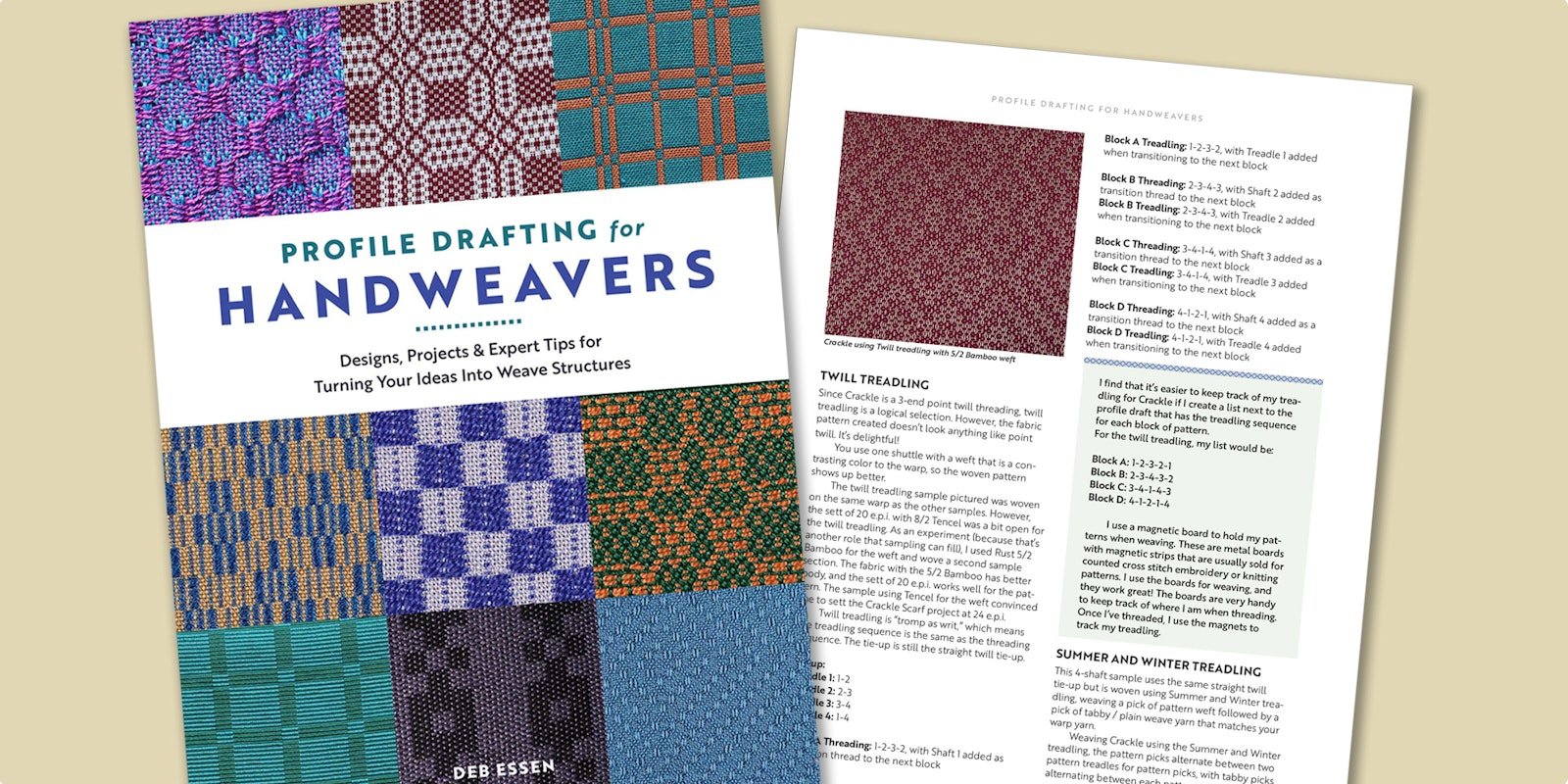
 The chapter for each structure includes information about its tie-up, threading, and treadling blocks. On this page, crackle is tromp-as-writ, with transition threads added between different blocks in both warp and weft. You don’t need a full draft to thread, tie up, or weave the crackle sample on this page—just follow the order of blocks in your profile draft.
Inside the Book
Essen’s book begins with brief chapters describing what profile drafts are, how they differ from thread-by-thread drafts, and how to design with them. The rest of the book covers 13 structures (among them M’s and O’s, Bronson lace, huck lace, turned twill, crackle, and overshot) and how to weave them using profile drafts, followed by a project or two for each structure. The book focuses on four- and eight-shaft weaving, but a threading unit chart shows how to use more shafts to weave additional blocks...
You’ll get the most out of this book if you resist the powerful impulse to skip all the words and jump ahead to the projects, tempting though it may be. While they’re attractive and well worth weaving...
In Good Hands
Working through this book feels like attending a superb weaving workshop—the author’s writing style is friendly and approachable, she works hard to explain concepts in a way that is easy to understand, and she stays focused on the topics at hand. Essen’s many years teaching weaving are evident. As she moves through the material, she knows just which questions will arise and when, and how best to answer them...
Read the full review in the Spring 2026 issue of Handwoven.
About the Book
Profile Drafting for Handweavers, by Deb Essen
Atglen, PA: Schiffer Craft, 2025. Hardcover, 192 pages, $39.99. ISBN 978-0764370007.