
Dear Madelyn,
I am fairly new to weaving. A kit I recently ordered includes a warp color order and a draft—and I’m lost. Can you explain the difference between these two charts, and how I should use them?
Thanks,
Judi
Hi Judi!
The standard ways weavers use to describe to wind a warp and thread the shafts can look complex and even off-putting at first. They’re a clear and efficient way to give this information, though, once you understand how they work.
About Warp Color Orders
A warp color order is used when a warp has more than one color (single-color warps don’t require one). It tells you the order in which to wind each color, and the number of ends used for each instance of a color.
They’re read in the same direction as drafts, usually from right to left. While a warp color order has rows that may look like the shafts in a draft, each row actually represents a color, as noted on the right side of it.

For the example shown above, you’d start by winding 4 black threads, then 8 green, and another 4 black. Then you’d wind 9 red alternating with 9 white for a total of 6 times (as indicated by the 6x bracket at the top). You’d end with 4 green and 4 black. The total number of threads of each color is listed on the left side of the chart, and the total number of threads in the warp is at the bottom.
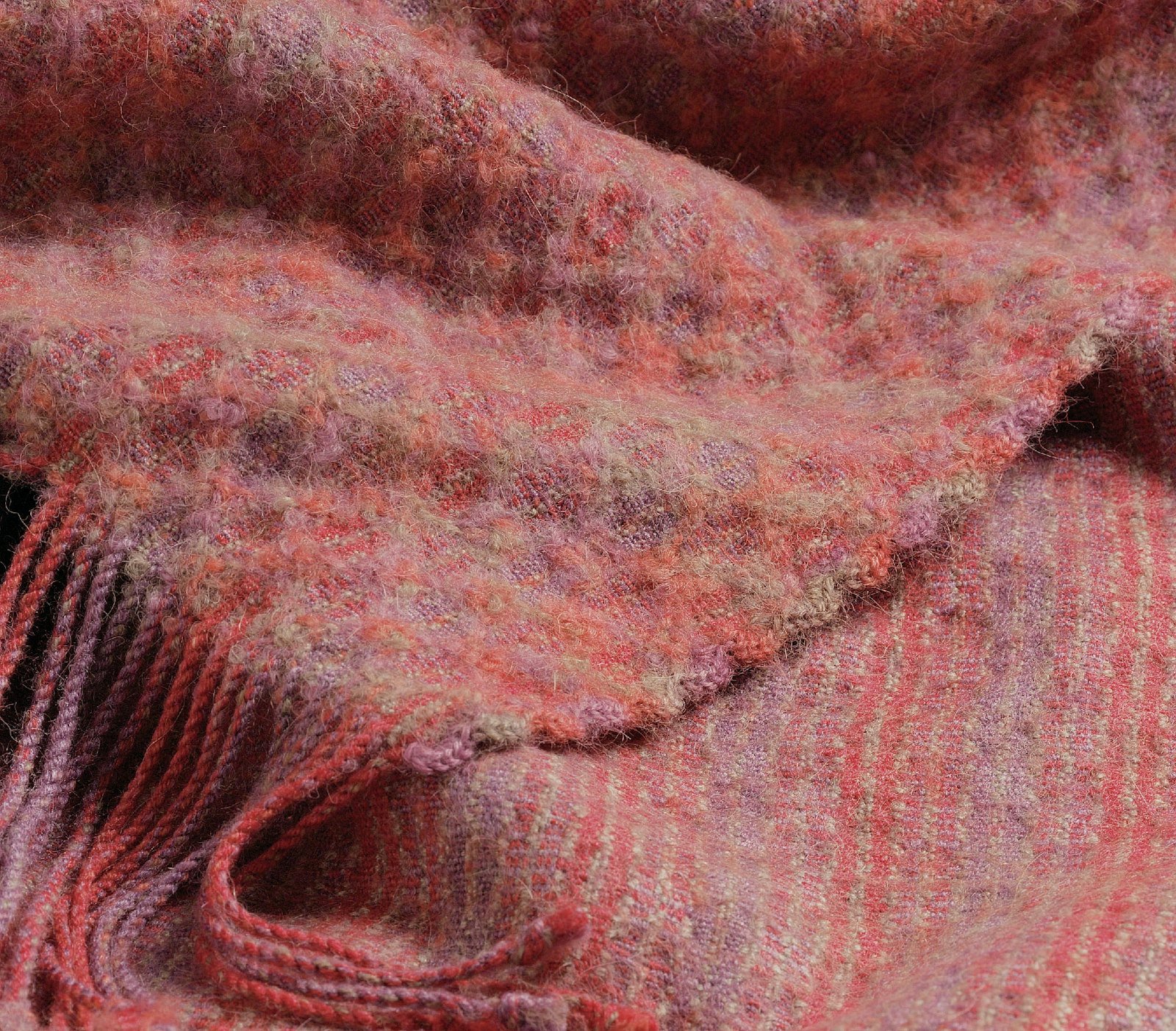
If the colors used in a project are more complicated, the warp color order will be, too. The photo at the top shows Sarah Fortin’s silk and wool deflected doubleweave throw (January/February 2010, page 48).

The warp color order for this project, shown above, starts with 1 Cinnabar, then another 6 Cinnabar, 2 alpaca (not a color, but clear in the context of this project), 6 Cinnabar, 2 alpaca. Then it alternates 1 Cinnabar and 1 Mulberry three times (as indicated by the 3x bracket at the top), and so on.
Notice that there’s also a 22x bracket above the whole section that begins with 6 Cinnabar. When you get to the last 2 alpaca under the 22x bracket, you must go back to the first 6 Cinnabar and repeat everything until you’ve followed the full bracket a total of 22 times. Then you end with 6 Cinnabar, 2 alpaca, and 7 Cinnabar.
 Sarah Fortin’s throw before fulling, showing sections of floats alternating with plain-weave cells.
Drafts are Different
A draft tells you how to thread the individual warp ends in a project. It’s also read from right to left; each row in it represents a shaft, starting with 1 on the bottom row. Read more about multishaft drafts.
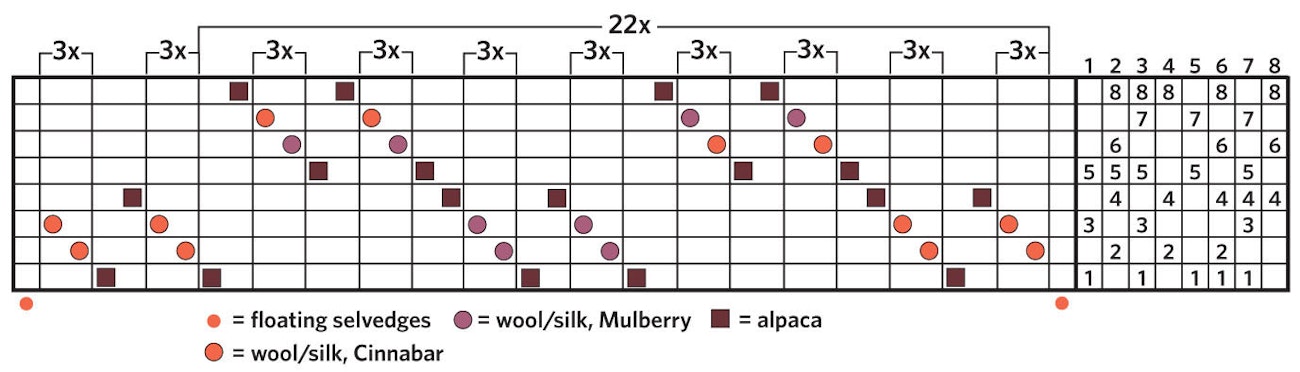
With this project’s draft (above), you would thread starting on the right with 1 Cinnabar (as a floating selvedge) and then shafts 2 and 3 three times, 4 and 1 once, 2 and 3 three times, and so on. You’d repeat the threads under the long bracket 22 times, just as you did for the warp color order.
You can see that the warp color order for this project is correlated with the draft, but the additional brackets in the draft make it harder to use for winding the warp. The warp color order summarizes just the information needed for winding.
Not all warp color orders and drafts are as closely related. In some projects they may even appear to be out of sync, especially if the two types of graphics use brackets for different numbers or lengths of repeats. For tricky projects I’m weaving, I sometimes even work through the warp color order and the draft manually, making notes about where color changes will occur on the draft.
Help from WIFs
Here’s where a computer can come in handy. If you have a weaving program, you can open a project’s WIF and easily view a full threading (including the warp colors in order) or treadling (including the weft colors in order), all without brackets.
With a paid version of a weaving program, you can print those full threadings and treadlings.
Then you can use your printouts to follow along and check off each color, shaft, or weft pick as you wind a warp, thread your loom, and weave your project.
—Madelyn
Originally published Feb. 12, 2018; updated June 29, 2026
If you have a weaving question, please email Madelyn!