

Hi Madelyn!
I want to design some towels in turned taqueté. I have not woven this structure before, but I love its patterning possibilities. The problem is, I have no idea how to sett a warp using 8/2 cotton. I’ve looked at a few different projects online and in the magazine and each one is sett differently: 20, 24, and 30. How does one determine the sett for turned taqueté for 8/2 cotton—or any yarn, for that matter?
Thank you!
– Erica
Hi Erica!
Taqueté (the not-turned version) is a weft-faced structure usually used for sturdy pieces, especially rugs. The warp is spaced relatively far apart, with two complementary wefts interlacing so that one of them shows on the face of a block, and the other on the back. Each of those two wefts passes over or under three warp threads and then under or over one warp thread.
Taqueté is a two-shuttle weave that requires a very firm beat—usually as firm as the loom and warp width will allow.
Turned taqueté is a warp-faced structure that is the result of turning a taqueté draft 90 degrees—its warp and threading become the new weft and treadling, and vice versa. It uses a single weft thread, along with complementary warp threads that interlace so one of them shows on the face of a block, and the other on the back. (I describe how to turn drafts here.)
Winding a turned taqueté warp can take a little longer because it uses at least two yarns (tip: hold them together as you wind), but the weaving goes faster because it requires only one shuttle.
In choosing the warp sett for turned taqueté, the first consideration is whether you can open a shed—a light loom will require a more open sett than a heavy loom. A second consideration is the desired hand of the finished fabric. For runners or rugs, the closer the sett of the complementary warp threads, the sturdier the fabric.
The number of picks per inch of the weft in turned taqueté depends. The closer the warp sett, the more open the weft sett can be. To plan runners or rugs using smooth strong warp threads, I’d wrap a ruler and then choose a sett close to the number of threads wrapped in one inch—and then sample! Your question, however, is about weaving towels. For the right fabric hand for towels, the warp should be much less dense than for rugs or runners.
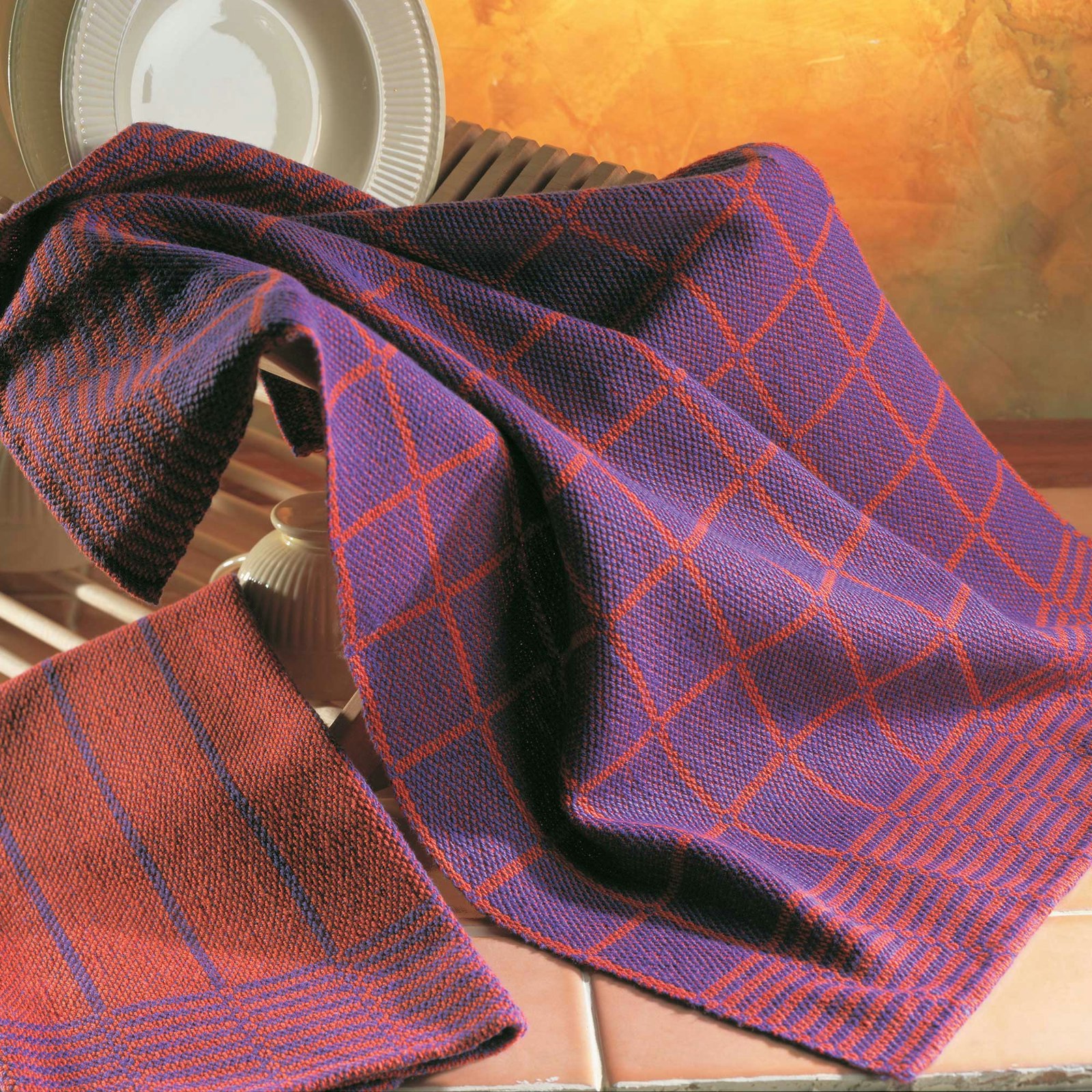
I’ve always loved Betsy Blumenthal’s Turned Taqueté Towels shown above, from the May/June 2000 issue of Handwoven, on page 36. (This project also appears in the Best of Handwoven: A Dozen Projects in 10/2 Cotton eBook.)
For 10/2 cotton, Betsy uses a warp sett of 30 and a weft sett of 20. Since 8/2 cotton (3,360 yd/lb) is heavier than 10/2 cotton (4,200 yd/lb), I’d probably start with a warp sett of 26—and then I’d sample!
– Madelyn
Posted March 30, 2016; updated June 16, 2017; updated May 13, 2026.
If you have a weaving question, please email Madelyn!